The Architecture of Journalism in the Age of AI
Journalism’s distribution architecture was built for a world that no longer exists. Search weakened it. Social platforms weakened it further. AI systems may remove it entirely. The Field Guide is a structural response: a blueprint for what news organisations should build to remain visible, trusted, and economically sustainable inside an information environment increasingly shaped by AI. The architecture described in this book is not an editorial vision. It is an economic proposition.
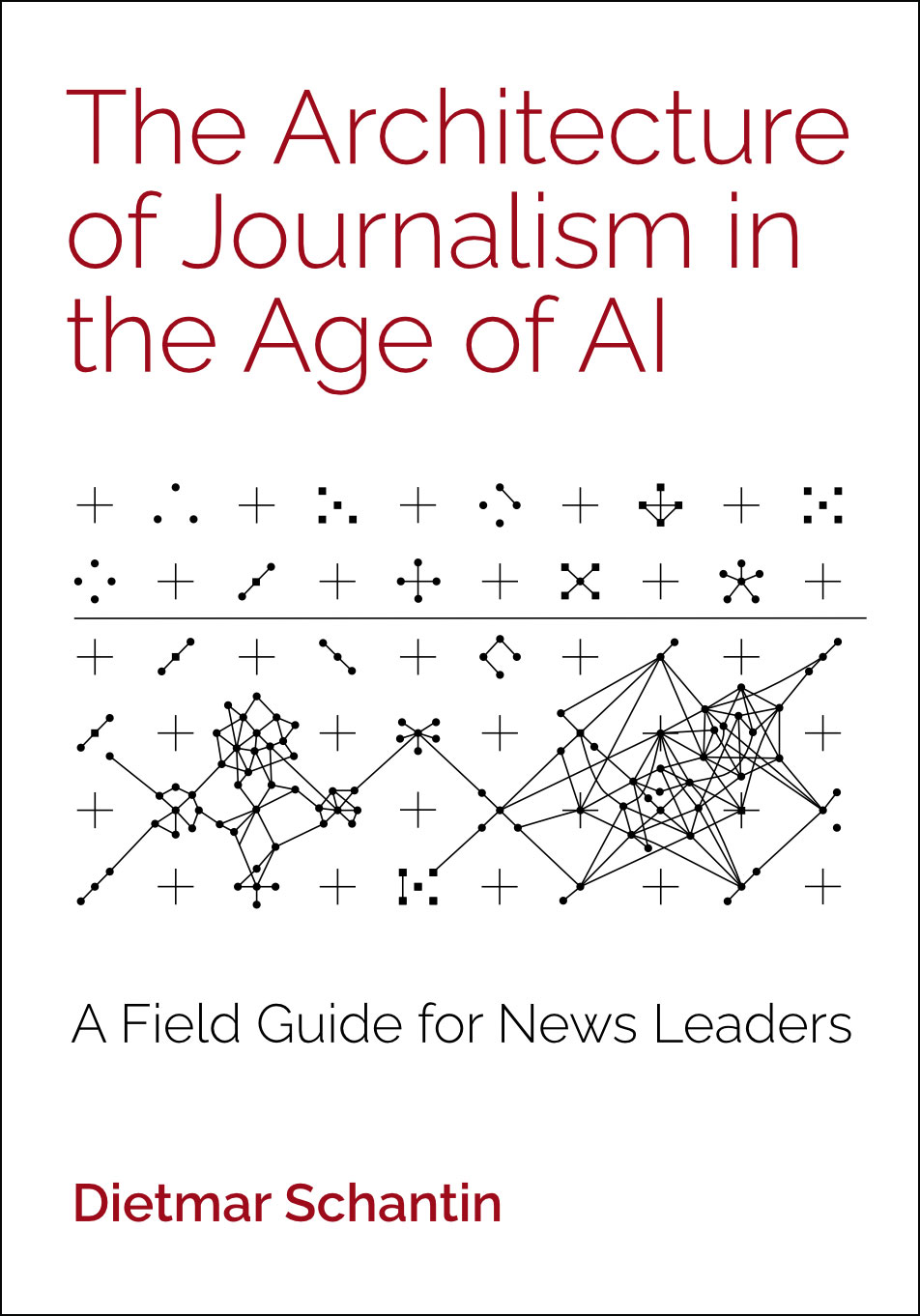
Five frameworks. Twenty chapters. Drawn from decades of transformation work inside the world’s leading news organisations. The Field Guide is due to be published in Autumn 2026.
Who is this book for
- Editors-in-chief who have to decide where AI fits inside the newsroom and where it does not.
- Publishers and CEOs who need a revenue model that survives the AI era, not a strategy deck that dies on contact with the next quarter.
- Heads of product who are tired of choosing between editorial integrity and platform mechanics.
- Senior journalists who want to understand the system they work inside well enough to change it.
Chapter Overview
Part One — The Crisis and the Case
Journalism is challenged in specific, diagnosable ways: a trust collapse that has reached historic lows, a distribution infrastructure being dismantled by platforms and AI systems, and a revenue model that served the industry for a century and no longer does. Part One maps the scale of the problem without dwelling in it. The purpose is not diagnosis. It is the case for an architectural response.
Better Canals — How We Got Here · The Trust Crisis · The Enshittification of Distribution · Why AI Changes Everything
Part Two — The Architecture
The five frameworks at the heart of the book. The DIKNW hierarchy (Data, Information, Knowledge, Narrative, Wisdom) defines where AI ends and human editorial judgment becomes irreplaceable. The atoms-and-molecules model restructures journalism below the level of the finished article — atoms as irreducible verified facts, molecules as purposeful assemblies of those facts into meaningful editorial knowledge. The two-layer architecture separates human-led knowledge creation from machine-assisted distribution, with an editorial firewall between them. The governance principles — the Trust-Authenticity-Personalisation Triangle (TAP) and the Visibility-Ethics Matrix — keep the system honest and editorially accountable.
The DIKNW Hierarchy · Atoms and Molecules · The Two-Layer Architecture · The Engineering Principles — TAP Triangle and Visibility-Ethics Matrix
Part Three — The Audience
Demographic and behavioural data tells you who people are and what they did. It does not tell you what they value or how journalism can serve those purposes. Part Three introduces values-based engagement and content tribes — the frameworks that turn audience understanding into editorial strategy and, ultimately, into a viable economic model.
Values-Based Engagement · Content Tribes · The AI Companion Economy
Part Four — Building
The architecture is the destination. Getting there is the subject of Part Four. Why most transformation efforts produce activity rather than change. What the barriers are, where they come from, and how to address them. The four-dimensional design framework — Product, People, Workflows, Technology — that makes Newsroom 5.0 possible. And the 80% Solution: the operational principle that makes the economics work.
The Barriers That Kill Transformation · Designing Newsroom 5.0 · The 80% Solution in Practice · Knowledge-First Workflows and the Teams That Run Them
Part Five — The Economics
Five revenue streams, ranked honestly by the strength of evidence behind them. Bundled subscriptions and events are proven at scale. AI licensing is generating real revenue with important caveats. Guidance services are early-stage but logically grounded. Community commerce is mixed and requires careful management. The Field Guide does not pretend otherwise. It closes with the defense against enshittification and a clear-eyed answer to the question every reader will have asked: why won’t the tech companies simply do this instead?
The Revenue Portfolio · The Enshittification Defense · Why Tech Companies Won’t Do This Instead · The Choice
“Belief in journalism’s importance to democratic society is where I start. But belief is not a business model. The architecture described in this book is not an editorial vision. It is an economic proposition.”
Introduction
“The platform can replicate the article; it cannot replicate the knowledge base.”
Chapter 6 – The Two-Layer Architecture
“Extraction-based journalism asks: how do we get people to do more of what we want? Service-based journalism asks: how do we help people achieve what they need?”
Chapter 8 – Values-Based Engagement
The Field Guide to Journalism in the AI Era — publishing Autumn 2026.
Enter your email and we’ll let you know when and where it’s available.