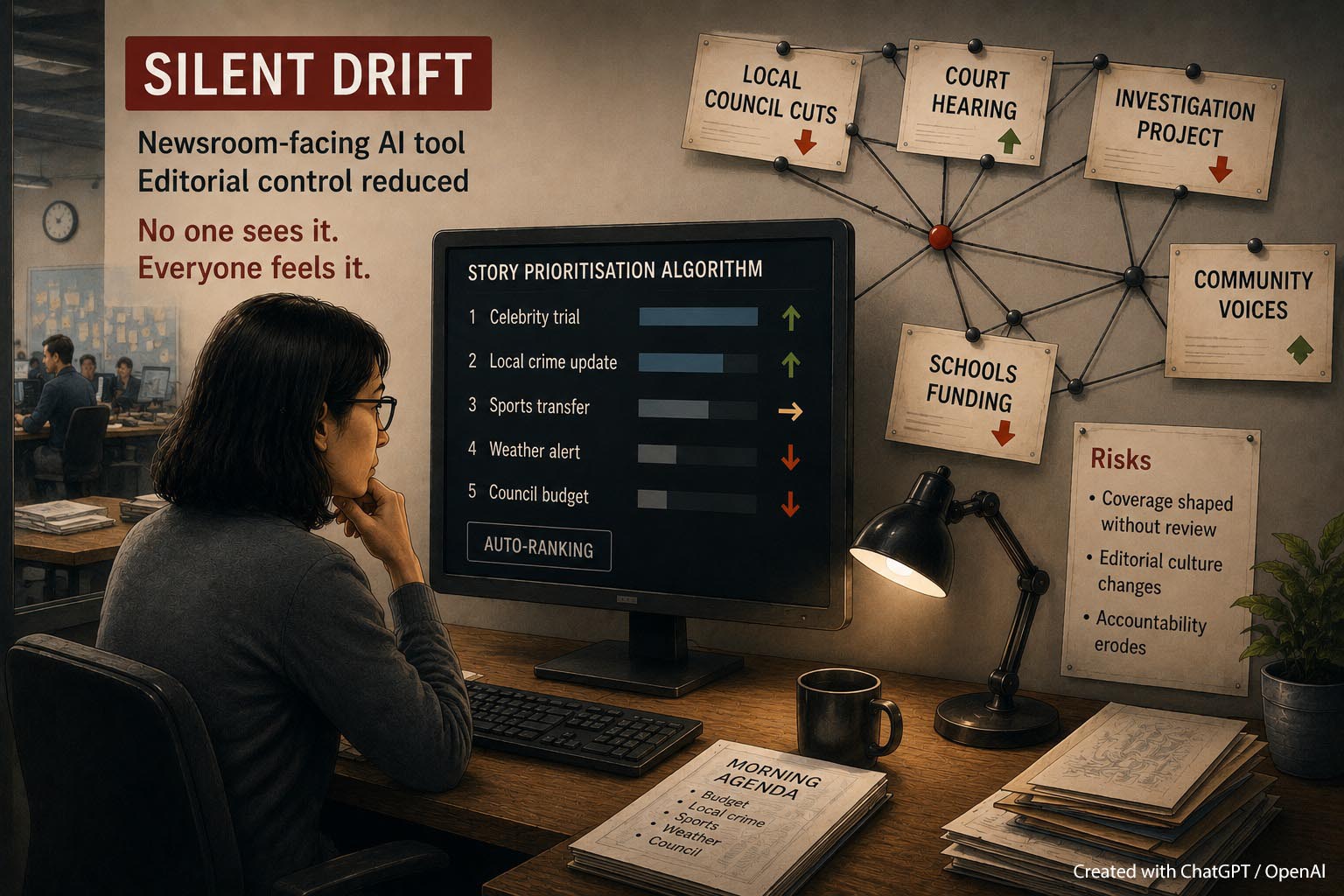
Field Note 04: Where No Alarm Rings
Summary: Some of the most consequential decisions in an AI-powered newsroom might be made by tools no reader ever sees and no editor reviews — a failure with no alarm attached. This issue names that failure, shows its pre-AI precedent, and sets it inside the Visibility–Editorial Control Matrix: an instrument that sorts every AI tool a newsroom runs into four quadrants, and tells you how hard to watch each one.
Somewhere in your newsroom, an AI tool that is hidden in a system, home-grown or from a third party, may already be making editorial decisions that no one reviews and no reader will ever see.
An AI research assistant may rank the online sources a reporter is shown, and over time, the same voices keep surfacing, and the range of what gets quoted narrows, with no one choosing to narrow it.
An overnight AI digest tool might score the wires or prioritise incoming emails before the desk reads them, and the stories or events it rates low are never pursued. But they are also never missed, because no one knew they were there. None of this is published, so none of it triggers the instinct that fires the moment an error reaches the audience. The tool’s logic becomes the desk’s logic, one unremarkable day at a time.
I call this Silent Drift, and it is the most dangerous thing AI does inside a newsroom, precisely because nothing about it looks dangerous.
An older mechanism, a newer speed
This is not a forecast, and the mechanism is older than LLM technology as we know it today. In 2017, researchers studying The Hamilton Spectator, a Canadian regional daily, found that the pageview targets sitting in the newsroom’s analytics dashboard had reshaped its editorial standards, with no one ever deciding to lower them. The numbers were simply there, every day, and the judgments bent towards them. Even journalists saw the numbers and made the calls themselves; the judgment was compromised, and it was conscious. Six months on, the editorial culture has changed shape, and the change is visible only in the rear-view mirror, if at all.
An automated AI tool removes this transparency. A system that ranks sources or scores stories does not show an editor a figure to weigh. It makes the call itself, continuously, with no single moment that invites a second look.
The instrument: the Visibility-Editorial Control Matrix
Silent Drift is one corner of an instrument I propose should govern every AI tool a newsroom runs in order to mitigate a common early mistake: to treat all AI tools alike, over-governing the trivial, under-governing the consequential, and spending editorial attention where it buys nothing.
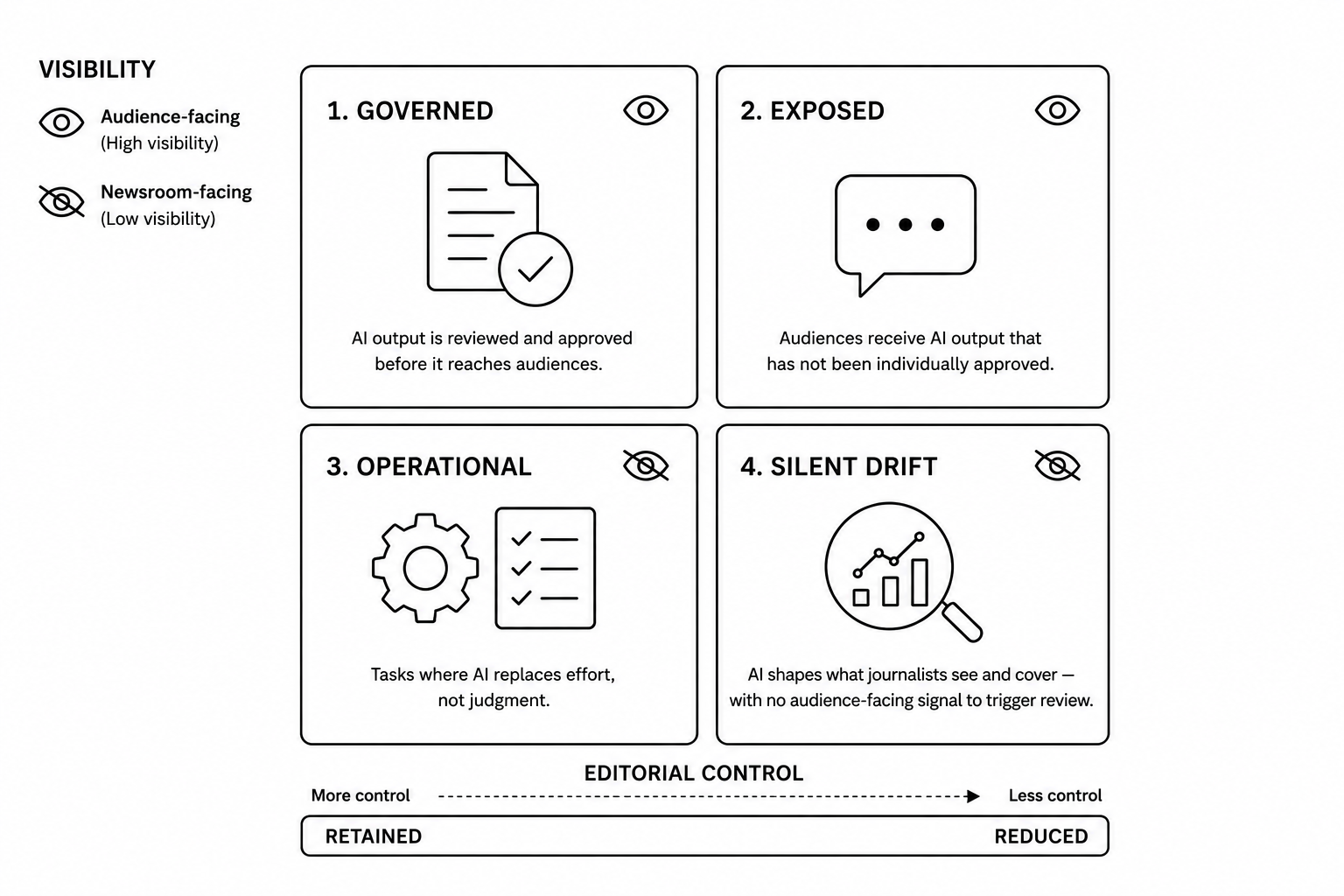
The instrument, which I call the Visibility-Editorial Control Matrix (VEC Matrix), asks two questions of any application. Who sees it: does it face outward, towards the audience, or inward, towards the newsroom?
And who is in charge of it: does a person still hold real authority over what it does, or has that authority been reduced, delegated, or surrendered with no one deciding to surrender it? Two axes, four quadrants.
The combination decides what governance a tool needs. Silent Drift is the inward-facing corner where control has slipped. The other three are easier to handle once you can see them.
The Governed quadrant: audience-facing, control retained
Two of the four corners face the audience. In the first, the Governed quadrant, editorial control is retained: an AI-curated newsletter that a journalist signs off, a council-meeting summary published only after an editor has read it. The distance between the raw material and what the reader receives has been closed by a human. That is managed risk, and it can be governed proportionately.
The Exposed quadrant: audience-facing, control reduced
The second corner, the Exposed quadrant, is the “costly mistakes” cluster, because control has been reduced. A chatbot built on verified journalism still generates each answer fresh, and hallucination and tonal drift are properties of the output, which no one approved. When McClatchy rolled a content-scaling agent across its papers in early 2026, more than thirty Sacramento Bee reporters withheld their bylines from work they had not written. The source material was sound. What readers received had not been signed off by the journalists whose names were on it.
The Operational quadrant: inward-facing, control retained
The last corner, the Operational quadrant, is the calm one: inward-facing, control retained — transcription, scheduling, metadata. Here the trap lies in different places. Govern your transcription software as heavily as your story-prioritisation engine and you have not bought safety. A headline-suggestion tool that editors approve by reflex is writing the headlines within weeks, augmenting the editor’s work becomes automating the editor’s work. This can happen very fast, because approval is the path of least resistance and there is always another story to edit. So watch the approval rate, and question it.
The AI the audience can see will always draw more scrutiny. It is the AI that the audience cannot see that decides, under the radar, what kind of newsroom you are becoming.
FROM THE FIELDS – THREE THINGS WORTH READING
Three months running an AI-assisted newsroom in a Pennsylvania news desert.
In March 2026 the journalist John McGuire launched an AI-assisted local news operation, Spring-Ford Press, in a Pennsylvania community that had become a news desert — and that is now a target for large-scale data centre development. Three months in, he reported three findings. Readers care far more about whether the information is clear, accurate and useful than about whether AI produced it; most of them, he wrote, “aren’t counting em dashes.” Transparency earns engagement: being open about the use of AI, and able to explain the process, brings readers along, including the ones who disagree. And building an AI-assisted newsroom from scratch proved easier than converting an existing one, because his readers met the operation as AI-assisted from the first day and were never asked to accept a change to something they already knew.
Researchers design a citizen-plus-AI local newsroom and put the human review where it counts.
A paper by Sangyun Lee and Kyungho Lee of UNIST in South Korea, presented at the 2026 Designing Interactive Systems Conference, comes at the same problem from the research side. They start from a tension inside citizen-participatory journalism: residents can submit local news, but what counts as news, and how it is framed, has stayed with the journalists’ editorial authority. They propose a platform that redistributes that authority without discarding it. A citizen submits a first-hand report; AI drafts it into article form and makes a first pass at ethical risks, redacting things like identifiable faces or licence plates; other residents add to the same story over a 48-hour window while the AI synthesises the contributions. Then a citizen–journalist group conducts the final review and decides whether the piece runs as is, is edited, or is withdrawn, with equal voting rights and a rule that any editorial objection be justified, so neither professional authority nor citizen voice dominates the call.
Set beside McGuire’s newsroom, this is the same instinct approached from the other end. He keeps editorial control of AI-assisted output by being a journalist and being open about it; the researchers ask what holds when the people drafting with AI are residents, not reporters. Their answer is the one this issue argues for. The AI does the input work, structuring, drafting, a first ethical pass, and the decision that reaches the public stays with humans reviewing the output. That is the Governed quadrant, designed rather than stumbled into. What I find more telling is that they took seriously the failure the lead essay warns about: a review that exists on paper but has stopped being a real evaluative act. Their mechanisms, rotating who reviews, equal votes, an objection that has to be justified rather than merely logged, are an attempt to keep the review genuine. Whether it survives contact with volume and deadline pressure is the open question, and to their credit the authors name it themselves: governance, accountability, and the traceability of who changed what, the AI included, are the hard parts still to be worked out. It is a design proposal no one has yet run in a real community. But it is reaching for the right thing.
BBC Eye built a multi-agent AI to sift 10,000 Russian posts, then chose to keep a reporter in the loop at every step.
For an investigation into Russia’s nationalist vigilante movement, the BBC’s investigations unit, BBC Eye, built a multi-agent AI system it called Haystack, with computational journalists from Stanford. Writing for the Reuters Institute, Christopher Giles, Serdar Tumgoren, Chris Zubak-Skees and Marc Perkins describe a tool that gathered 10,000 social media posts from more than ten nationalist groups and produced 55,000 assessments of them, flagging nationalist ideology, references to migrants, anti-migrant raids and calls for violence, work that would otherwise have taken weeks or months by hand. What matters is a choice they made and explain. The team built, and then rejected, a more automated version in which the agents would collect, assess and analyse from a single prompt. They found that having a reporter give instructions at each stage cut the model’s tendency to guess and wander, kept human oversight over what the agents decided, and surfaced more precise leads, which the team then verified by hand before trusting them.
This is the lead essay’s warning answered from the inside. Haystack is a newsroom-facing tool of real power, exactly the kind of system that, left alone, drifts into the quadrant where editorial control slips unseen. BBC Eye did not leave it alone, keeping the human in the loop is what made the output good enough to report. The supervised system surfaced more precise leads than the automated one. That is augmentation holding its line against automation. One honest qualifier: this is a flagship investigation, a small expert team, every incentive to check. Silent Drift does its damage in the opposite conditions: the routine, high-volume tool nobody is excited about and nobody is watching. BBC Eye shows the discipline is possible. The essay’s warning is about everywhere it is absent.
This issue gave you the instrument for governing AI tool by tool; the next turns from the tools to the people they serve, and to the case for understanding an audience by what it values rather than by what it buys. Until then, a question for your own operation: which of your AI tools currently has no alarm on it — nothing that would fire if its judgement went wrong where no reader could see? Hit reply and tell me which corner it sits in.
Until next time,
Dietmar
The Field Note: Twice a month, for editors, publishers, and heads of product working out what AI means for their newsrooms. One piece of original analysis. Two things worth a senior reader’s time.