Field Note 01: Better Canals
Summary: Thirty years of digital transformation built better canals. The AI era requires a railway; a different value proposition, a different architecture, and a different operating system. Where those sit, what they consist of, and why your AI policy cannot do the work of all three.
Let me tell you a story about phase change.
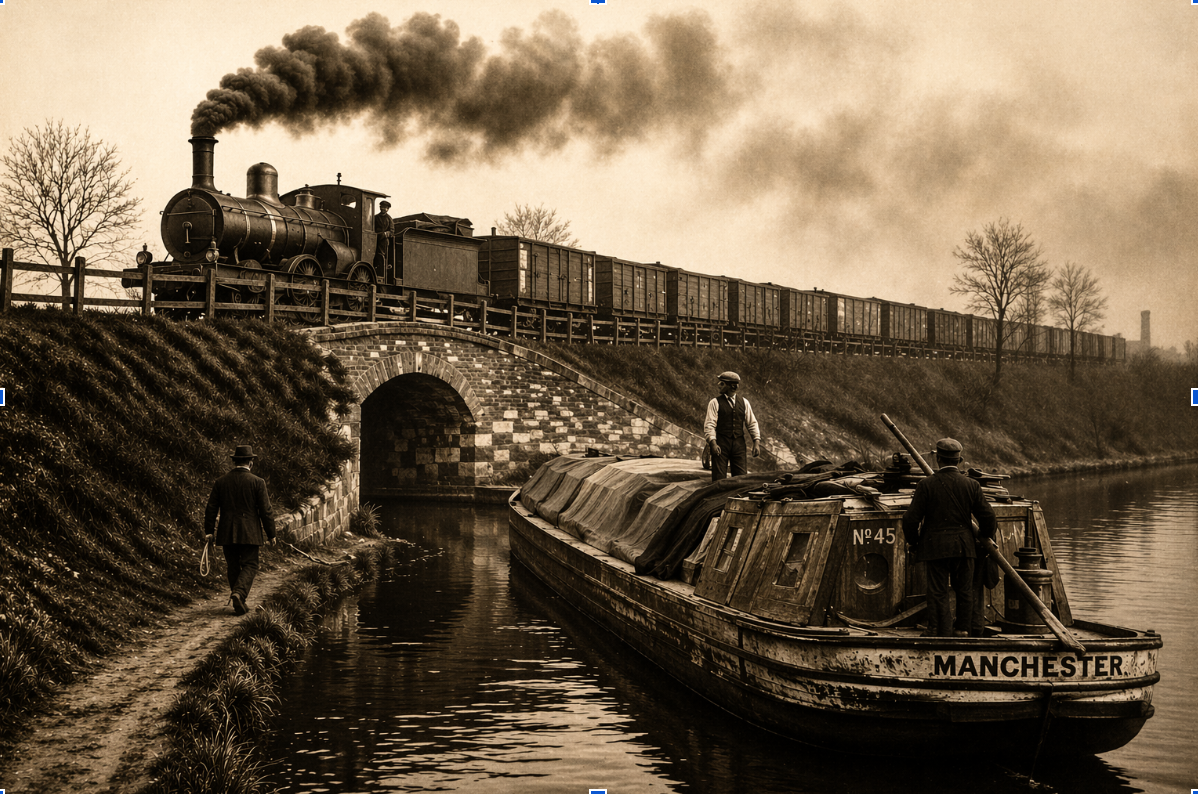
For most of the 18th and early 19th century, British canals were the most sophisticated logistics operations in the world. Lock systems so precisely calibrated that narrowboats could ascend hundreds of feet and pass over aqueducts across valleys. The engineering was extraordinary. But by 1850, the work was increasingly irrelevant. The railways did more than move goods more quickly; they enabled an entirely different economic geography. The question was never whether canal boats could match railway speed. It was whether water-based transport had a role in an economy organised around rail.
Newsrooms now face a phase change of that order. AI is more than a tooling question or a platform pivot. It demands that we answer fundamental questions. What is the value of human journalism? Where does that value reside in an AI-enabled newsroom? When we cannot see how the tools work — the black box problem — how can we be transparent and accountable? And what prevents the same extraction dynamics that have degraded every consumer platform from degrading ours?
These are not tooling questions. They are architectural questions about what kind of news operation we want to build.
Newsroom design has gone through four iterations in thirty years. Newsroom 1.0 bolted a small digital annex onto the print operation. 2.0 tried a matrix of reporters serving print, web and broadcast through a coordinating editor. 3.0 brought section heads to own stories across formats. 4.0 put mobile at the centre. I helped design some of these canals — The Telegraph in London in 2006, The Wall Street Journal during their mobile-first shift, Handelsblatt from 2019. Each was an intelligent answer to the conditions of its era. Each delivered real improvements. And each was, at bottom, a better canal.
Today, content itself is no longer what audiences need most from journalism. Anything we publish is available elsewhere within minutes — through aggregators, social feeds, and AI assistants that summarise it before the reader reaches us. What remains scarce is judgment. Context. The institutional expertise that helps people work out what information actually means, and what to do about it.
Once that is the proposition, the questions change. Three of them matter most.
First: what roles must human journalists always play, and why? Not which tasks to automate this quarter. The deeper question. Where, in the production of judgment rather than the production of content, does the human contribution become structurally non-negotiable? My answer, which Issue 2 will develop fully, is that the human contribution sits at the point where information becomes narrative — where data and reporting are turned into something a reader can use to understand and act on the world. Almost everything beneath that line can be assisted by machines. The line itself cannot.
Second: as newsrooms build AI-driven personalisation deeper into their subscriber products, what prevents those products from degrading over time? A subscriber product that gets gradually more aligned with what keeps the user clicking, and gradually less aligned with what the user needs to know, is not a hypothetical. It is the default outcome unless something inside the architecture prevents it. The safeguard cannot be a policy. There has to be a structural separation — a wall between the layer where journalism is created and the layer where it is personalised and distributed.
Third: you probably have an AI policy by now. Almost everyone does. But a policy tells staff what they may and may not do with the tools currently in front of them. An architecture defines how the human knowledge layer and the AI distribution layer relate to each other. An operating system defines how decisions are taken inside that architecture, day by day, when the policy does not give an obvious answer. Almost none of the AI policies I have read are sitting on top of an architecture or an operating system. They are doing the job of all three, and they cannot.
Those three questions are what this newsletter exists to explore. Together they describe what I have come to call Newsroom 5.0: not a faster version of the four newsrooms that came before, but the railway to their canal. They form the spine of The Architecture of Journalism in the Age of AI, which will be published later this year. The Field Notes will give you the working argument as it lands, ahead of the book.
FROM THE FIELDS – THREE THINGS WORTH READING
McClatchy’s ‘content scaling agent’ and the byline problem nobody has solved yet
Unions at the Miami Herald, the Sacramento Bee and the Kansas City Star have filed grievances against McClatchy over its new AI tool; a Claude-powered system that takes reporters’ published work and generates summaries, audience-targeted rewrites and video scripts. Management pitched it as “Grammarly on steroids.” Reporters called it a betrayal of the public’s trust.
Organic search clicks down 42% across 64 publisher sites
Define Media Group’s analysis of Google Search Console data finds the decline is concentrated in informational and evergreen content. The same period shows breaking-news traffic up 103% across Google Search, Discover and Google News (Search Engine Land; AP Workflow Solutions, Reuters Institute Predictions 2026 Scorecard).
The Guardian finds the middle ground on AI
The Guardian’s Storylines: a careful AI deployment toward the reader. The Guardian has rolled out Storylines, which clusters recent headlines on a topic into three narrative threads with AI-generated subtitles, designed to help readers find their way around large topic pages. Inputs are limited to headlines only — no full-text summarisation — with senior-editor review, limited rollout and an off switch.
I include this because it is a useful counter-example to the idea that the only choice is full-fat AI summarisation or none at all. There is design space between those two positions, and Storylines is sitting in it.
Issue 2 takes up the question this one ended on: where, in a working newsroom, does the human contribution actually sit? I would like to know how it reads from where you are. If you have led one of these newsroom iterations, or are partway through the next one, hit reply and tell me what you think the canal-builders of our era got right — and where you think the railway is. Good ideas are best shared.
Until next time,
Dietmar
The Field Note: Twice a month, for editors, publishers, and heads of product working out what AI means for their newsrooms. One piece of original analysis. Two things worth a senior reader’s time.