Field Note 06: The Offer Changed. The Newsroom Did Not.
Summary: Every one of the world’s fifty largest news brands now bundles. The offer has changed a great deal; the organisation producing it has changed hardly at all. This issue uses two news subscriptions — one owned outright, one arriving inside a bank’s benefits list — to set out the difference between packaging what a company already has and building around a community that already exists.
Over a dozen subscriptions leave my account each month. Most are not media at all: software, storage, a magazine, the ordinary running costs of a digital life. Two are news publishers, and only one of them arrives inside somebody else’s package. The Financial Times comes as a benefit on a Revolut card, alongside ChatGPT since August, a meal-delivery service and a VPN, and a number of other perks I neither need nor use.
Bundling has won the argument. Greg Piechota tracks the subscription offers of the world’s fifty largest news brands by digital subscriber base for INMA, and his March analysis found not one holdout among them. Every one now packages something beyond plain text news. Ninety-six per cent have folded extra benefits (apps, personalisation, podcasts, video) straight into the core subscription, and a small majority go further, selling separate products together at a discount. His summary is blunt: the subscription has stopped being a single news product. It is a structured package of use cases, built to be opened more often.
The offer has also started to change shape. Piechota finds product lines reorganising away from content and towards segments. Dow Jones now runs several Wall Street Journal subscriptions where it once ran one, divided by how professionally the reader uses it. Le Monde has been testing packages that reach outside journalism altogether, as far as Spotify and HBO. The shape is the same in each case. One product for everybody has given way to several, aimed at different needs, different levels of engagement, different willingness to pay.
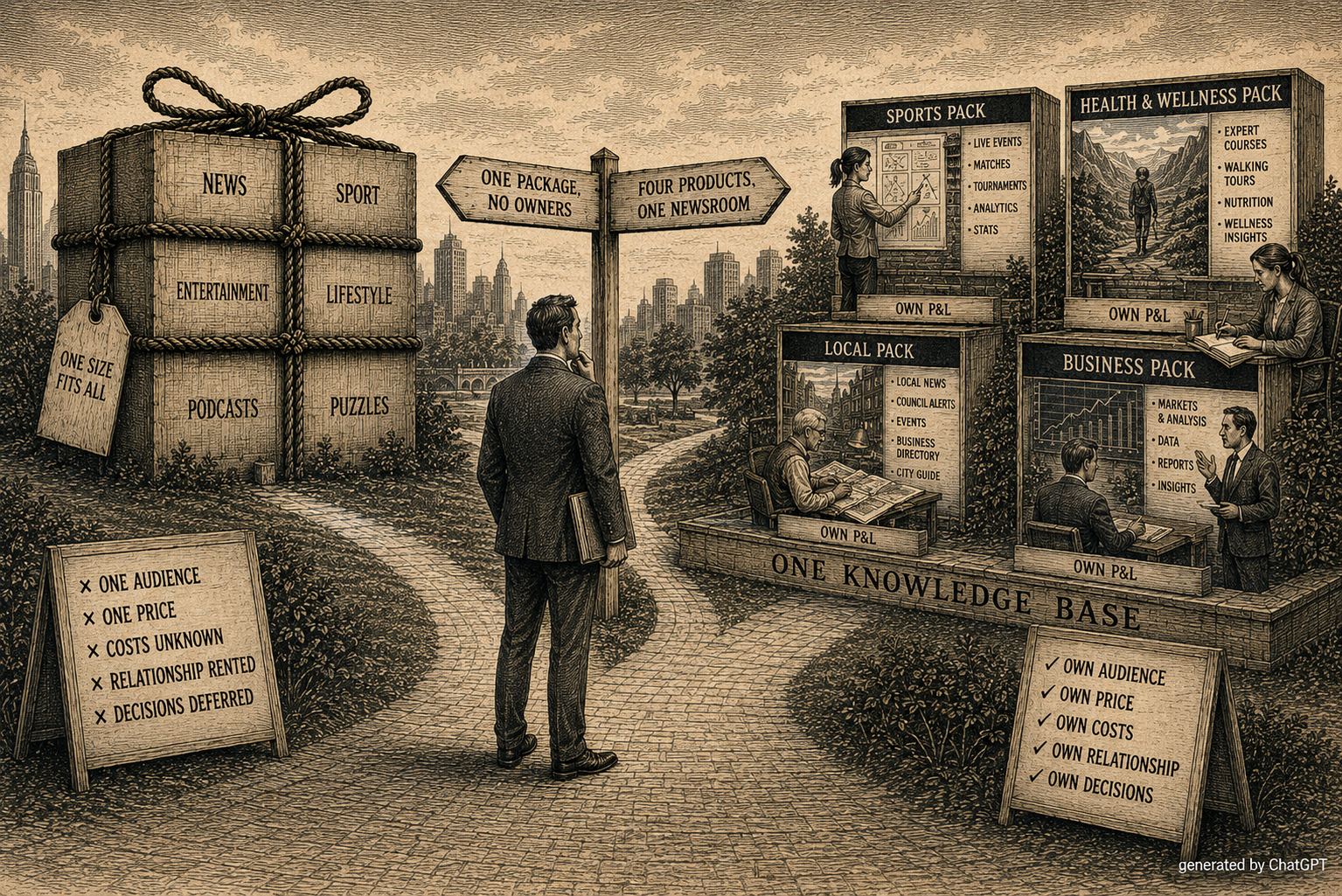
That is the right direction. It is also a decision about the offer, and in most organisations I work with it stops there. The portfolio changes. Underneath it, the sports desk still reports to a managing editor, still competes with politics for the front, and nobody in the building can say what either one costs or earns.
The two news publishers in my portfolio sit on opposite sides of a line.
The New York Times owns everything about its arrangement with me. It sets the price, holds the renewal, sees what I open and what I ignore across the whole package, and decides what goes into that package next. When it discovers that a subscriber uses Cooking more than news, it can act on the finding: reprice, repackage, commission differently. That is what a bundle is worth to the company that owns it.
The Financial Times knows I registered and can see what I open. It cannot see what else the card is for, whether the meal service gets used, or how much of the attention it competes for goes elsewhere. It does not set the price, hold the renewal, or own the decision to keep it there. And it cannot tell whether it is the reason the card gets used or one of the perks nobody opens.
Revolut recently dropped Perplexity from the benefits list and replaced it with ChatGPT. No subscriber was consulted, and none needed to be. If a news brand goes the same way it will not have lost an argument with its readers. It will have lost a negotiation it was never party to, and will then have to win them back in open competition with the whole package it used to sit inside.
One of those arrangements is a subscriber relationship. The other is rented space in someone else’s product.
Owning the relationship is where this starts, and it is not where it finishes. The Times got there deliberately, over a decade, in part by paying several hundred million dollars for a sports title. That option is not on the table for a regional publisher. The question is what deliberate segmentation looks like for a company that cannot buy its way to inventory, and the answer is to build around a community it already serves. In the context of news I call these content tribes. The old package was a mixture of topics, organised by newsroom section. The new package is a mixture of content and services, organised around a single interest.
Which makes a local tribe something quite different from a metro section. It is local reporting and investigation, and also a city guide, a business directory, council meeting alerts, neighbourhood events, and an AI companion that knows the area because it was built on a decade of the paper’s own coverage. It has its own audience, its own price, and its own reason to exist. The brand becomes an umbrella. The company becomes a portfolio manager.
None of this requires the Times’ scale. Ibbenbürener Volkszeitung, a German local paper with a print circulation of around 25,000, organised its newsroom around topic areas (local, business, recreation) in the middle of the last decade. Readers paid per topic, or a flat rate for the lot. It worked, and it did not spread, because at the time a topic package could offer little more than a filtered stream of articles. What has changed is the layer underneath. A tribe can now carry an assistant that knows a decade of the paper’s own reporting, which is the difference between a bundle of sections and a service.
Bundling products is a pricing decision, and all fifty of the largest have now made it. Rebundling around audiences is an organisational one, and that decision is still sitting on the table.
FROM THE FIELDS – TWO THINGS WORTH READING
The Economist for You
The Economist has launched what it describes as its only personalised newsletter. Each Friday, as the new weekly issue reaches phones and newsstands, an in-house AI model combs the week’s coverage and compiles a reading list, drawn from reading history and from topics the subscriber has chosen to follow, excluding anything already read. The promise is careful: the same rigorous journalism, organised with the reader in mind.
This is personalisation applied to a bundle that already exists. The model works after the week’s journalism has been commissioned, reported and edited, choosing among finished articles rather than shaping what gets made — reordering the shelf rather than deciding what goes on it. If an AI can build a bespoke edition for every subscriber, why segment at all? Because personalisation answers a question about distribution. Tribes answer one about production.
AI in journalism: live tracker of scandals and mistakes.
Charlotte Tobitt keeps a running list of every confirmed case of AI going wrong in a newsroom. It now runs from CNET in 2023 to the Financial Times this month, where a Harvard economist’s opinion column carried a note saying AI had been used to condense a longer draft before submission, in breach of a code that prohibits AI in the writing process. Read the whole list rather than the latest entry.
What it shows is that almost none of these were failures of technology. Berlingske’s guidelines permit AI for research and summary and prohibit it for article production; a journalist used a summarising tool and it produced quotes from an article that was never included. Ars Technica had a written policy warning against exactly this and fired a reporter who fell into it anyway. Politiken had built a fact-box tool grounded in its own archive, and someone used an open chatbot instead. The rules existed. What did not exist was any point in the process where a human was required to verify before publication. That is an architecture problem wearing the costume of a policy problem, and it is the reason a policy document is not a safeguard.
Next time, the question this issue raises and does not answer. Organising around tribes means deciding how far the independence goes: whether it stops at editorial, extends to running each tribe as a business unit, or goes all the way to separate profit and loss statements. Those are three different companies, not three stages of the same one, and most of the argument about content tribes is really an argument about which of the three is meant.
Until then, a question worth putting to your own operation. Of the sections you publish, which one could stand alone tomorrow, priced on its own and accountable for its own numbers? And which one is being carried by the rest? If the answer requires asking finance, that is the finding.
Best wishes,
Dietmar
The Field Note: Twice a month, for editors, publishers, and heads of product working out what AI means for their newsrooms. One piece of original analysis. Two things worth a senior reader’s time.