Field Note 07: Who Owns the Numbers?
Summary: Most publishers know what a department costs. Far fewer know what an audience is worth, and only 6% of newsrooms let a desk spend money on its own initiative. This issue sets out the three ways a newsroom can be organised around content tribes, and what each one does to autonomy, accountability and the figures nobody has assembled.
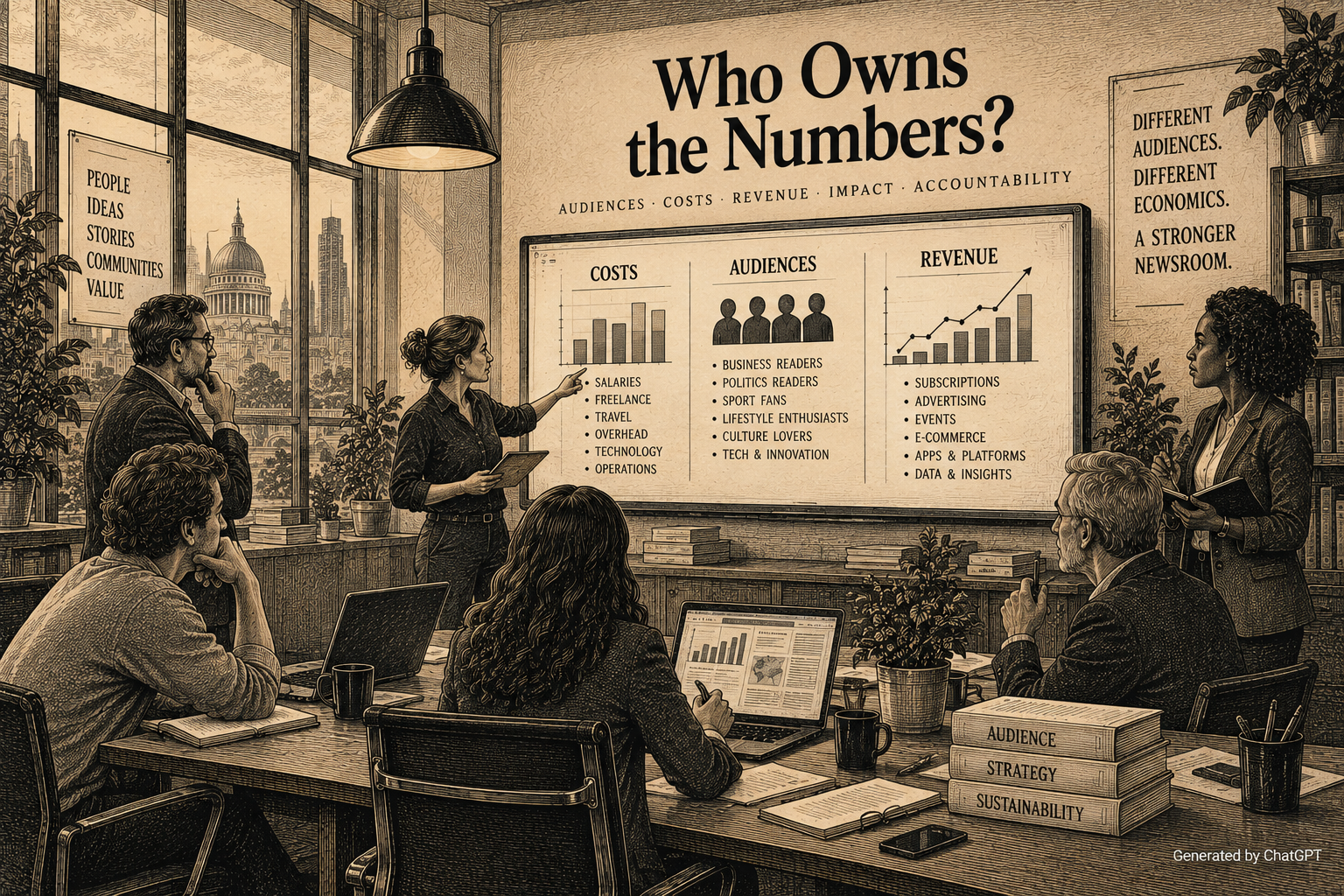
Most publishers can produce a cost figure for a department. Salaries, freelance budgets, travel, a share of overhead: the finance team allocates it, and business, politics, sport and features each have a number attached, more or less reflecting reality.
Far fewer can put revenue against those same units. Fewer still can do it for an audience, which is a different question again: not what the business desk costs, but what the people who come for business coverage are worth. That figure is what organising around audiences depends on, and in most companies it has never been assembled, because often the required data does not exist in the form that would have been needed.
FT Strategies and WAN-IFRA found this year that 55% of newsroom leaders believe their current reporting lines are fit for purpose, with confidence falling thirteen points when they look three years out. More telling: only 6% of newsrooms give desks any spending autonomy for new initiatives. Christian Tretbar of Tagesspiegel puts the consequence plainly in the same report: editorial teams need responsibility and the P&L, or these structures do not work. He is right that business accountability has to move. The question is how far.
Eleven years ago I was writing about building verticals around the interests of parts of a publisher’s customer base, with journalistic offerings alongside non-journalistic ones such as events, e-commerce and specialised apps, each vertical carrying its own monetisation and cost strategy. What has changed since is that the organisational and technological layers underneath, which did not exist then, now exist or can be built.
In the book I set out three levels of unbundling and autonomy. They are three organisational concepts built around content tribes, an evolution of those verticals, focused on the shared interests of people and served by an aligned ecosystem of editorial products, services and other offerings. Each concept comes with a different degree of autonomy, transparency and accountability.
Content unbundling with centralised operations
The focus here is mainly on content and customer experience. Editorial teams decentralise by topic area, and each tribe has its own editorial focus, voice and content strategy, its own newsletter, its own events, its own space in the app or even its own tribe app, perhaps its own revenue model. The other business functions stay central: one subscription team handles all tribes, one data analytics team provides intelligence, one events team organises across topics, one advertising team sells across all content areas, and one product and engineering team creates the experience for each tribe. This allows content specialisation while maintaining operational efficiency, although keeping shared standards across the tribes is something that needs to be managed. The offer changes, the organisational structure largely does not. The figures stay where they always were, but the more decentralised editorial decision making drives more audience centricity.
Complete unbundling with independent profit and loss
At the other end of the spectrum, each tribe operates as an independent business with its own financial accountability: its own publisher, editor-in-chief, subscription team and commercial operation. Several companies under one umbrella brand. Each tribe is accountable for its own performance and can pursue a different business model, adapting everything from content to pricing to distribution for its specific audience without compromise. The parent becomes a holding company supplying brand credibility, shared infrastructure where beneficial, and overall strategic direction. This gives the greatest freedom, and the greatest responsibility, to make journalistic and business decisions.
Operational unbundling with shared profit and loss
In between, operational independence pushes down to each tribe while financial oversight stays unified. Each becomes a business unit with an editorial lead, a dedicated subscription manager and an events coordinator, people with deep knowledge of their audience who can move without waiting for the central organisation and its committees to decide. They all report into one consolidated profit and loss statement. This balances tribal autonomy against institutional coherence: the tribes move faster than a centralised structure permits, while the shared statement maintains accountability and prevents fragmentation.
Why move at all
There is a reason to do any of this, and it is not accountability. Centralised structures have achieved a great deal in this industry: consistent standards, efficient use of scarce specialists, a coherent front page assembled by people who could see the whole. What they have not achieved in most cases is closeness to the audience or speed of response to changing markets. A decision that has to travel up to editorial leadership and back down, through the committees most newsrooms still use, arrives after the moment that prompted it has passed. Pushing autonomy towards the people who know a particular audience is what makes an organisation nimble, and nimbleness is what makes innovation possible at all: the ability to try something quickly, without the case for it having to survive three levels of approval first.
What becomes visible
Assembling the economics of each tribe will reveal that investigations may not pay because of the low volume, that uninspired council coverage does not pay either, and that some of the most valuable journalism for the civic function in the building is carried by games, cooking apps and service journalism.
In the old bundle, profitable sections subsidised unprofitable ones invisibly. Nobody knew what sport cost against what politics cost, or how much subscription and advertising revenue each generated. Everything was mixed. In the tribe model each product’s economics become visible, and that visibility is uncomfortable, but healthy. It forces honest conversations about which coverage justifies its cost through direct reader value, and which coverage serves a civic function that requires cross-subsidy from more commercially viable tribes.
FROM THE FIELDS – TWO THINGS WORTH READING
Apple launches a new way to prove a photo was shot with an iPhone
Apple Reference Image arrives with the iPhone 18 Pro. With the feature enabled, a photograph is saved twice: once as a normal editable image, and once as a reference version carrying a unique ID in its metadata proving the frame was captured by a real camera sensor rather than generated by a model. Capture telemetry is sent to Apple’s Private Cloud Compute to produce a cryptographic signature, and the signed image can be shared with the signature intact for later verification. Apple is opening a Reference Image API across iOS, iPadOS and macOS.
Joshua Benton’s framing is the useful one. Google’s SynthID embeds a signal in the pixels of a generated image to declare that it is fake. Apple’s does the opposite, and does it in the metadata rather than the picture: it declares that this one is real.
Footballco says AI assistant helped it reach 1bn+ World Cup page views
Footballco’s assistant, Goal-e, is trained on twenty years of Goal’s own content. During the 2026 World Cup its brands drew 114 million users and more than 1.1 billion page views, with Goal itself up 42% on users against 2022 and 55% on page views. Organic search rose from 58% to 65% of traffic across the same period, while AI Overviews were rolling out. Output is labelled — AI-generated, AI-assisted, AI-translated.
The detail worth pausing on is a World Cup final piece written by a Dutch journalist at Voetbalzone, translated for the Japanese edition, where it drew 803,000 page views. The chief technology officer’s account of why this works is that translation frees reporters to go deeper on football-adjacent culture, fashion and business.
That is a single knowledge base serving several audiences in several languages, with the reporting done once. It is also worth noting what Footballco is: a portfolio spun out of DAZN in 2020, comprising Goal, Kooora in Arabic, Calciomercato in Italian, Spox in German, Voetbalzone in Dutch, and a quarterly print magazine. Not a newspaper with a sports section.
Next time, why none of this happens. Past issues have described what a news organisation could be. The harder question is why organisations that understand the argument, and often agree with it, arrive at the same place two years later with the same structure. The obstacles are rarely the ones named in the strategy document. In the book I set out what actually stops transformation, and most of it is neither technical nor financial.
Until then, a question worth putting to your own operation. If a desk head wanted to try something small next month — a newsletter, an event, a partnership — how many people would have to approve it, and how long would it take? The answer is a measure of how fast the organisation can learn anything.
Best wishes,
Dietmar
The Field Note: Twice a month, for editors, publishers, and heads of product working out what AI means for their newsrooms. One piece of original analysis. Two things worth a senior reader’s time.