Field Note 08: Ten Ways to Stall
Summary: When newsroom transformation for the AI era stalls, the cause is seldom the technology budget or the tools. Ten barriers recur. Some come from not knowing what is being built, or why. Some come from changing one place while the rest of the organisation stays as it was. The rest come from not resourcing the people doing the work.
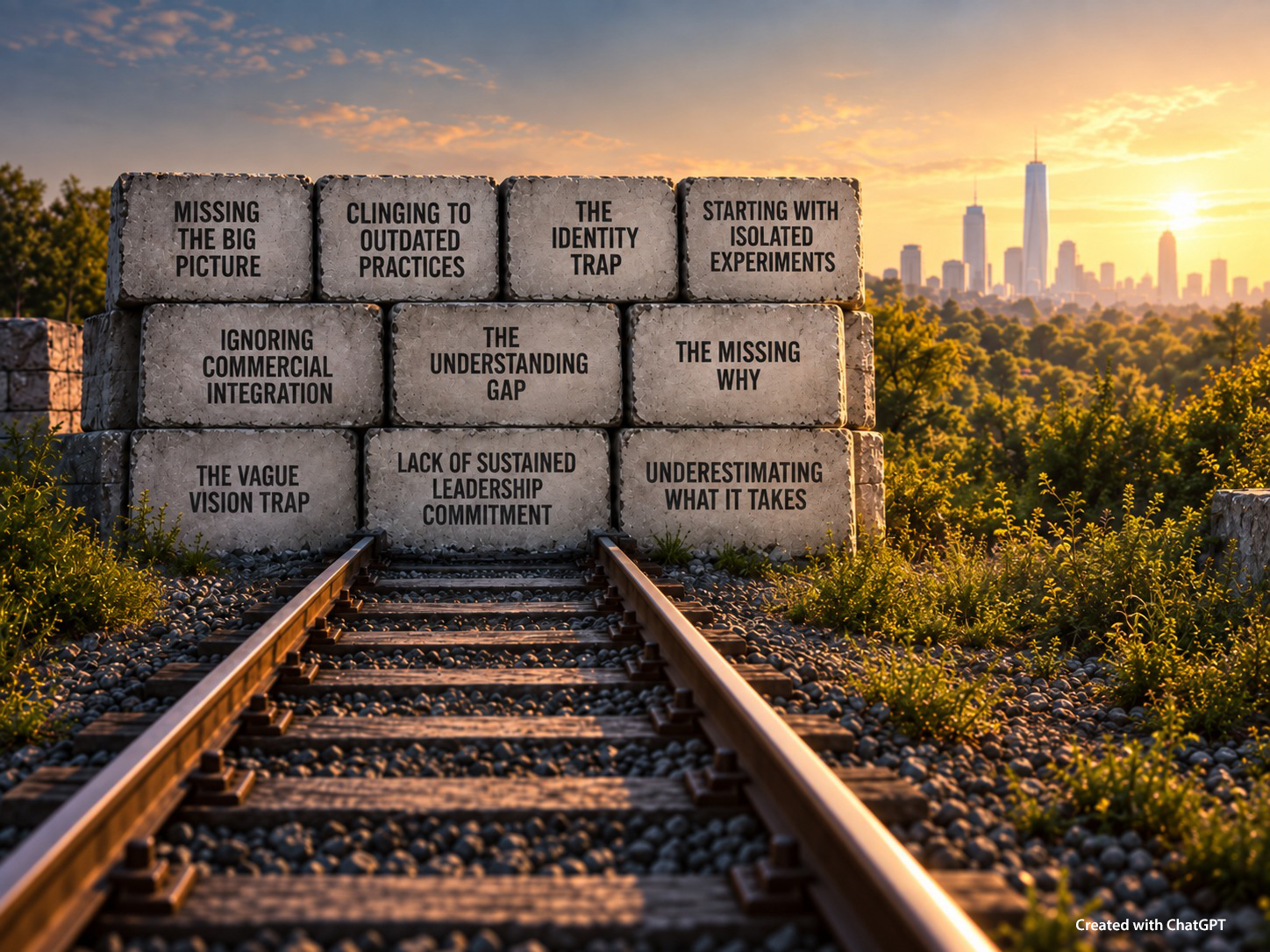
Over more than twenty years of working with newsrooms on change, I have seen first-hand where transformation projects stall, and it is very often in the same places. The same failure points recur in the AI era. In my forthcoming book, I name ten barriers, each drawn from that experience, and I don’t claim that this list is complete. Few come down to the technology or the sophistication of the AI tools, and none reflects the intelligence of the people involved. The barriers to transformation are structural and, not surprisingly, very human.
Not knowing what, or why
The first group of barriers is not knowing what is being built, or more importantly, why. The missing why is the higher-level barrier. Most newsrooms can say what they do; but far fewer can say what changes in a reader’s life because they exist. Just saying ‘quality journalism’ offers no principled answer when trade-offs arrive. The vague vision trap is aspirations without a concrete, describable future state. It’s a statement too loose to test any decision against.
A better discipline is to describe, in the present tense, what someone visiting the newsroom two years from now will see. The understanding gap is the technical form: editorial, product, and technology teams lacking enough understanding of one another’s domains to co-create effectively. The remedy is co-ownership, with editorial helping to define the architecture before product specifications are written.
Change in one place
We might group the second set of barriers as changes that are made in one place while everything else stays as it was. Missing the big picture is the purest form: it is fixing one element in isolation rather than moving product, people, workflows and technology together. Clinging to outdated practices is the newsroom version: attempting to layer new technology onto old journalistic workflows. Isolated experiments are the structural version: innovation labs and pilots that never become the core operating model. Ignoring commercial integration: treating transformation as an editorial/technology project rather than an organisation-wide business transformation.
Not resourcing the people
The third group of obstacles to transformation is not resourcing the people who have to do the work. Underestimating what it takes: insufficient people, time, expertise and organisational firepower. When I work with a newsroom, I usually ask who its most valuable person is. That person, or someone of equal calibre, should run the project full-time. My rule of thumb is to take whatever resourcing seems reasonable, and double it. The identity trap: resistance driven by changes to professional role, status and identity, not simply a lack of skills. What is threatened is identity and status, and that calls for an explicit, early conversation about what changes, what stays and how careers progress. A lack of sustained leadership commitment kills transformation slowly. Resources drift to the next crisis and hard decisions get postponed, and staff conclude that leadership did not mean it.
Each of the ten barriers maps back to a framework in the book, and that is deliberate. These barriers are failures of architecture, not of intelligence or intention. The transformation frameworks exist because, without them, the barriers have a good chance of winning.
FROM THE FIELD – TWO THINGS WORTH READING
From guidelines to architecture: How newsrooms are rethinking AI governance
The safeguard nearly every newsroom relies on for AI is the one being overloaded. Ramaa Sharma spoke to 20 newsroom leaders, experts and academics in 13 countries about how they govern AI. She found three approaches: tools used ad hoc with no formal policy; guidelines backed by cross-departmental committees and human review of AI output; and, in larger organisations such as the BBC, YLE and Czech Television, dedicated Responsible AI leads and teams. Almost all of them treat human oversight as the primary safeguard, and it is showing strain. The governance work lands on middle managers who are already carrying the daily operation. ‘That middle manager level is super packed,’ said Annika Ruoranen, formerly Responsible AI Lead at YLE. Scroll in India has capped how much AI-assisted output staff are expected to review. Sharma cites an FT Strategies and WAN-IFRA survey of 448 newsrooms in which 57 per cent had no AI representation in their organisation. Her conclusion is in the title: governance has to move from written policy into the systems themselves.
Read this beside the third group of barriers. Oversight of AI is being added to the desks of editors who already run the daily operation, which is the part-time project leader in another form: the work is real, nobody has been freed to do it, and when pressure rises the day job wins. The piece also reaches this issue’s conclusion from the governance side. Rules on paper depend on tired people catching every error. Oversight built into the structure of the content carries some of that weight itself, as Scroll is attempting by labelling its journalism with provenance at sentence level. The atoms-and-molecules model in the book points the same way.
Adapting Large Language Models to Swedish Journalism Through Continued Pre-Training
A newsroom’s own archive can make an AI model better at journalism. Researchers at Linköping University and Bonnier News took 21.7 million Swedish articles published by Bonnier titles between 1991 and 2026, cleaned them down to 14.6 million, and used them to continue training two of Mistral’s Ministral 3 models. To test the result, they built their own benchmark of six editorial tasks: headlines, leads, bullet-point summaries, topic classification, identifying the people, places and organisations central to a story, and general-knowledge quizzes. The adapted models wrote better headlines, leads and summaries and held more factual knowledge, with the largest gains on the quizzes. They got slightly worse at classification and entity extraction. Training on news alone made the models worse; it worked only when code, English and general Swedish text were mixed in. On EuroEval, a general Swedish benchmark, the adapted models scored below the model they started from on average. The losses came mainly on tasks translated or generated from English; on natively Swedish tasks, the better-performing variant roughly matched or narrowly beat it.
The most useful result is about measurement. The standard Swedish benchmark said the adapted model had got worse; the newsroom’s own tests said it had got better at the things a newsroom does. A publisher that lets someone else define ‘good enough’ will be told its tools are succeeding or failing by the wrong test. The second lesson sits in the data. Thirty-five years of archive is an asset, and on its own it was not enough: the model needed the wider world mixed in to stay useful.
A welcome to anyone reading for the first time. Field Notes arrives twice a month, drawn from the book I have written.
A question for your own operation: which of the ten is costing you most right now? Hit reply and tell me.
Best wishes,
Dietmar
The illustration was created by ChatGPT
The Field Note: For editors, publishers, and heads of product working out what AI means for their newsrooms. One piece of original analysis. Two things worth a senior reader’s time.